Showing posts with label Images. Show all posts

Wednesday, July 04, 2012

Smart Logos, Sordid Realities


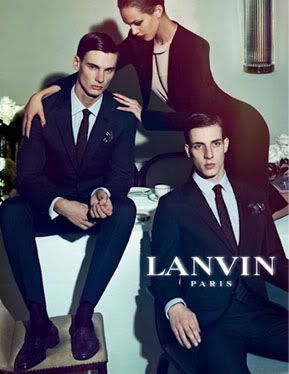
Tiberge, the blogger at Gallia Watch who helps us "stay au courant of what French patriots are doing and saying," has posted an image of the logo for Pôle Emploie, the French government agency that registers the unemployed and helps them find work, alongside a photo of a disheveled individual running down some steps (second image above). I found the bigger image posted on Le Figaro. The out-of-focus photo of an Arab looking man interacting with what looks like an employment counselor (the fourth image) is from Le Nouvel Observateur. The others are in various news or blog sites, and more logo/people juxtapositions can be viewed here (many are strangely out of focus, but this photographic choice of image is probably to preserve anonymity and not to identify individuals - the racial background of some of these is hard to decipher).

This is a smart logo, carefully designed most certainly by a professional graphic designer, who must have put in quite a few hours and won over several competitive designs, to have his selected for the agency.

Yet, the sordid realities of French unemployment is juxtaposed next to this smart logo. The disheveled youth, the Muslim man, the black guy, the white girl with unkempt blond hair, are not smart enough for the logo.

And an even smarter photographer has taken the logo with a special effect which makes the image look as though it is splintering or breaking apart (bottom photo). An apt symbol for the over-loaded agency, and for France.

Read More...

Tuesday, May 08, 2012

Moving Forward!

Mengistu Haile Mariam with raised fist

"Mitt Romney Makes Fun of Obama Campaign Slogan During High-Dollar Fundraiser" says this headline, but Romney is not wrong, although a little naive. The article says:
Mitt Romney this evening, speaking to a group of high-dollar donors at the Ritz-Carlton hotel, poked fun at President Obama's newly unveiled campaign slogan, "Forward," remarking, "Forward, what, over the cliff?"
"Forward" is actually a communist/socialist slogan which this Washington Times article correctly identifies:
The Obama campaign apparently didn't look backwards into history when selecting its new campaign slogan, "Forward" — a word with a long and rich association with European Marxism.
African Marxist countries also used "forward" as a slogan. "Etiopia Tikdem," which loosely translated is "Ethiopia First" but actually means "Let Ethiopia Come First" or "Let Ethiopia Go Forward," was a well-known slogan during Marxist Ethiopia.

"Etiopia Tikdem" on a helmet

Even non-Marxists like us liked the sound of it for a while. Some still use it, a little nostalgically and ironically. Here is a blogger, whose name is Etiopia (it is common to give girls the name "Etiopia"), who uses it as her Facebook title. She's too young to have lived through the worst of the communist regime, but somehow the phrase has prevailed, and she associates with it positively.

Read More...

Wednesday, March 07, 2012

Going to the Other Side

Going to the Other Side
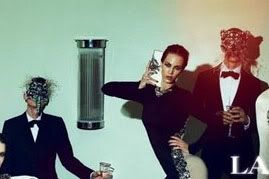
(Lanvin's Spring/Summer fashion ad)

[Notice that the image on the right looks like a mirror image of that on the left (or vice versa)], but it isn't. I tried to do a mirror image match of the woman in pink with photoshop, but couldn't. And the light reflecting on the snake's head on the right isn't on the snake's head on the left.

Lanvin is literally taking us to the "other side," the alternate reality, where things look the same, but aren't.
]

--------------------------------------------------------------------------


Eve seems to be a recurring theme in fashion magazines (and fashion) these days. Recently, I blogged about the fashion house Blumarine, and its use of a female model in close association with a snake, from the snake skin attire that she was wearing to a strange conversion of her persona into that of a snake.

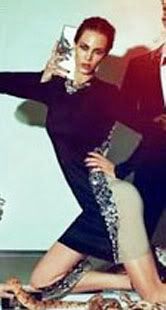
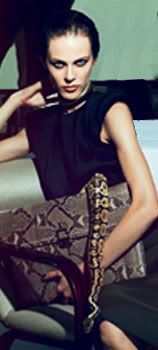
Lanvin seems to be on a zealous mission to bring Eve and the snake to the forefront, even more so than Blumarine. The March 2012 Vogue issue has a three-page Lanvin fashion ad where snakes are everywhere. Some (a few) are cleverly incorporated into the women's clothing and accessories, not as patterns nor their skin as the material for the clothing, but as sculpted three dimensional forms, almost alive in their sinewy presence. Most of the snakes, though, are crawling through the pages.

The writhing snakes are always in close proximity to a woman, and their relation to the males seems to be dictated by the women. For example, the complete version of the Eve/Snake shoots, available online here, has a sado-masochistic bondage scene. A man is lying down with his hand tied down with a snake while a woman threateningly brings a snake close to his face, as though to release the snake's poison on the man.


Where the man is holding a snake, he seems to have less control over it. Some snakes wrap themselves around a man's wrist or arm, acting as handcuffs or ropes to tie him down. Others slither across men's bodies (shoulders, arms, legs).


The women are sinewy and active, while the men are sitting or standing stiffly, like lifeless mannequins (a role reversal, since we are used to seeing female mannequins). And the men are often positioned lower than the women, reinforcing the female dominance.

The women's faces in all the photos are fully exposed. And despite their similar looks, with sleeked back hair (to resemble the snake), they still have distinct, strong personalities. The men have stunned expressions, and their hardened features are not as strong or as confident as the women's. In the image at the beginning of the post, the men are anonymous, their faces covered with masks to erase their identity and individuality.

[Close-up of the top image, showing men's masked faces]
The women are not interested in seducing the men, despite their provocative, aggressively female dress and posture, but in subduing them.


The sinewy, domineering women seem to have become snakes themselves. And having stunned the men into wooden passivity, they crawl all over them at their pleasure.

The snake has made woman his ultimate accomplice. And she has taken her complicity to the final level, where she is renouncing herself to become like, or be one with, the snake.


The Lanvin ads, with their clever associations, have made woman the protagonist in their images. This is easy to accept since women are always dominant in fashion shoots, fashion is about women. In the imagination of fashion photography, and in women’s fashion fantasies, modern sex relations can resume where the Garden of Eden ended. Eve finally does take over.


Read More...

Saturday, December 24, 2011

Sacredness of Art?


Many times, it is during these holy days that we contemplate the images that depict our sacred Biblical characters.

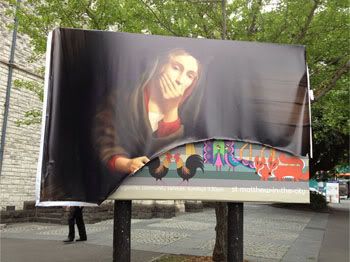
There is a discussion going on at Larry Auster's View From the Right about the recent image of Mary holding a pregnancy test which was cut to shreds by Catholic traditionalists in New Zealand.

A VFR reader writes, "I'm surprised by the fact that you cherished what can only be considered an act of barbarism."

Auster succinctly replies: "...you are sure that people who properly take action against intolerable things are morally backward."

That is just it. Non-Christians love to quote, or allude to, the "turn the other cheek" line in the the New Testament:
But I tell you, Do not resist an evil person. If someone strikes you on the right cheek, turn to him the other also. [Matthew 5:39]
I think they do this so that they can get away with their ultimate purpose, which is to destroy Christianity, and to have no retaliation in the process, having turned these "devout" Christians into inert bystanders.

When someone (or some people, or a whole society) starts the systematic destruction of our religion, standing by passively (and "piously") is actually sinful. We are allowing the message and word of God to go to ruin, destroyed by forces that hate it.

The other part of this story is of course that cultural items like paintings are more sacred than or equal to God. Therefore destroying them becomes worse than upholding God's name.

The poster itself is more than a poster. The artist has clearly spent time trying to make a pretty good painting of the Virgin Mary, using classic drawing and painting techniques. He isn't merely using a "poster" as a propaganda tool, but a work of art that mocks all other religious art which depict Mary in a true, holy manner. This ugly (not aesthetically, but morally) painting of Mary fools people into thinking it is the erudite, well-thought out, submission of an artist, when in fact it is mocking everything Mary, and God, stand for.

Therefore, the right reaction for this ugly work is to cut it to shreds with scissors, just as the Christians in New Zealand instinctively and confidently did.

The "reason" given for putting up this poster by the Anglican church St. Matthew-in-the-City is the usual "Christianity as a vehicle for social change" where:
Mary was unmarried, young, and poor. This pregnancy would shape her future. She was certainly not the first woman in this situation or the last.

As in the past it is our intention to avoid the sentimental, trite and expected to spark thought and conversation in the community. This year we hope to do so with an image and no words. We invite you to wonder what your caption might be.

Although the make-believe of Christmas is enjoyable - with tinsel, Santa, reindeer, and carols - there are also some realities. Many in our society are suffering: some through the lack of money, some through poor health, some through violence, and some through other hardships. The joy of Christmas is muted by anxiety.

In this season we encourage one another to be generous to those who suffer, to give to strangers, and to care for all – especially those who have the least. Like the first Santa, St Nicholas did. [From the St. Matthew-in-the-City website]

Read More...

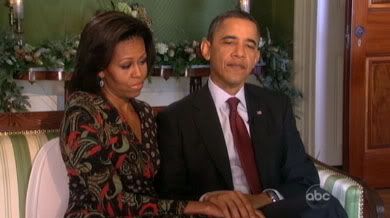
The Clutching Obamas, Again

Ample space on the sofa for several others

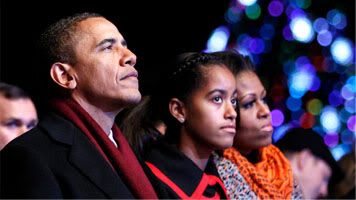
The Obamas during their interview by Barbara Walters for
her Christmas at the White House special

[Video here]

I've written (or more precisely posted many images) on the formality and decorum that US presidents showed in public appearances, and how that has devolved into some kind of public display of exaggerated clutchings and hand-holdings. The Obamas are big on clutching and hand-holding. Linked above is their Christmas at the White House interview with Barbara Walters on 20/20 just yesterday, where they don't once let go of each other's hands, and sit so close together that I thought the seat was too narrow. As the picture above shows, there is ample space for several others.

Read More...

Thursday, December 22, 2011

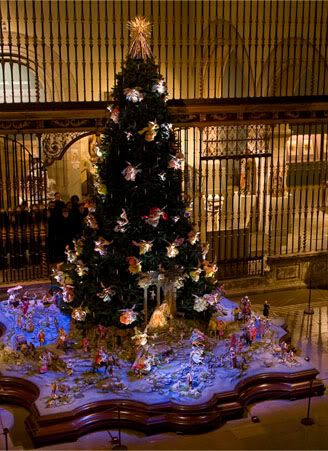
Christmas Tree at the Metropolitan Museum of Art

Christmas Tree with Neapolitan Baroque Crèche
at the Metropolitan Museum of Art, New York

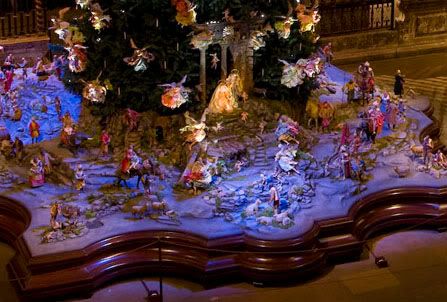
(Detail) Neapolitan Baroque Crèche at the base of Christmas Tree

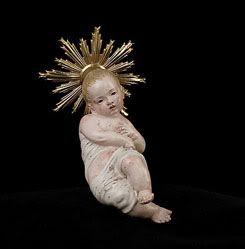
Infant Jesus by Guiseppe Sammartino (1720-1793)
From the Crèche

[All images from the Met website]

Each of the figurines under the tree is apparently created by a different artist. The baby Jesus above is by Giuseppe Sammartino (1720–1793). He is with Mary, who is under the pillars (with the cherub flying in between). Joseph is standing behind Mary.

The Metropolitan Museum website has images of 233 artworks of the tree and the crèche, which includes the figurines and some of the designs that went in their creations. The very first page has descriptions of the figurines of the holy family.

-----------------------------------------------------------------------------------------------------

It is the Christmas season, and Christmas trees are everywhere, so I cannot help but comment on them.

Despite their name change (Eaton Centre calls theirs a "Wish Tree") and odd shapes (Dundas Square - across from the Eaton Centre - has mounds of snow made of wire that make a tree), they still give a festive air to these days.

Above is a tree I saw at the Metropolitan Museum of Art, which seems to be a long-standing tradition at the museum.

It is hard to see all the pieces from the images above, but in front of the pillars are Joseph and Mary with the infant Jesus, and the various wise men (on horseback, camel, and elephant) are on either side of the family. Shepherds are there too, as well as angels. And many "ordinary folk" including "a man with bagpipes" and "girl carrying a basket of onions" amongst many others.

Here is more on the tree and the crèche from the Met's website:
The annual Christmas display is the result of the generosity, enthusiasm, and dedication of the late Loretta Hines Howard, who began collecting crèche figures in 1925 and soon after conceived the idea of combining the Roman Catholic custom of elaborate Nativity scenes with the tradition of decorated Christmas trees that had developed among the largely Protestant people of northern Europe. This unusual combination first was presented to the public in 1957, when the Metropolitan Museum initially exhibited Mrs. Howard's collection. More than two hundred eighteenth-century Neapolitan crèche figures were given to the Museum by Loretta Hines Howard starting in 1964, and they have been displayed each holiday season for nearly forty years. Linn Howard, Mrs. Howard's daughter, worked with her mother for many years on the annual installation. Since her mother's death in 1982, she has continued to create new settings for the Museum's ensemble and additional figures that she has been lending to the collection. In keeping with family tradition, Linn Howard's daughter, artist Andrea Selby Rossi, now joins her mother each year in creating the display.

Read More...

Monday, December 19, 2011

More on Presidential Family Portraits

Malia Obama in 2011

In my previous post, Presidential family portraits, I tried to make a comprehensive analysis of the presidential portraits through the centuries. I should add that my critiques of the paintings and photographers are mostly cultural rather than aesthetic. Even the family sprawl of the Kennedys is endearing. Except when it comes to the Obamas, whose family portraits I really find odd and off-putting, with all the clutching that is going on.

But to describe a little more the aesthetic decisions in the portraits:

The perching on the arms of chairs (in the Truman family portrait and the Nixon family portrait) I think are aesthetic choices by the artists. In the Truman portrait, a type of pleasing triangular structure is formed, with Margaret appearing higher (standing would make her too high) to form the triangle. This is a common portrait strategy, which I describe here. This triangular form is somewhat used in the the Roosevelt photograph.

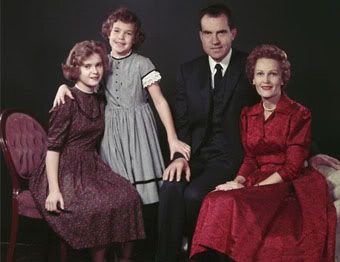
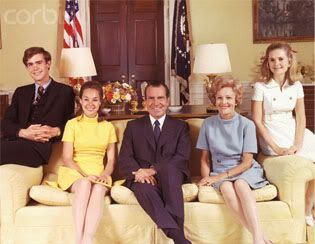
Framing the image is another common strategy, which is evident in the Nixon family portraits. In the top one, the older daughter and the mother frame the photograph. In the later portrait, David Eisenhower sits beside his wife Julie Nixon, perched on the sofa arm, (yes, the photo does attempt casualness), while Patricia Nixon completes the frame on the other side of the  sofa. There is also an attempt at symmetry, with President Nixon flanked by his (colorfully dressed) wife and daughter.

But, I wasn't trying to revisit these portraits. As I was looking through the many images out there of the Obama children, I was struck by the masculine, flat expression on Malia's face in recent photos (2011 especially). She used to look pretty as a little girl. It seems that some of her mother's empty harshness, and her father's arrogant air has rubbed on to her.

Read More...

Saturday, December 17, 2011

Presidential Family Portraits

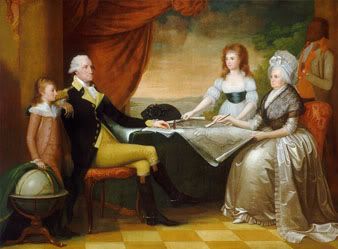
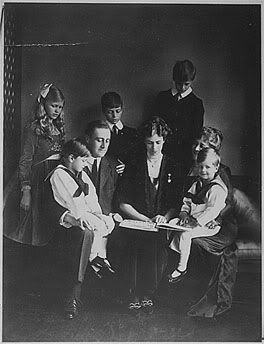
Early presidential family portraits tend to be less formal than the presidents' portraits. Families are often sitting, gathered around a table, engaged in small activities which often consist of reading to one another.

Despite this casual air, almost all presidential family portraits nonetheless display some air of formality. Parents sit upright. Small children may be on laps, but seated, not sprawling. Standing members don't lounge, but lean gracefully on the backs of chairs or on a shoulder.

The Washington Family
By Edward Savage
Oil on Canvas
1789-1796
Andrew W. Mellon Collection
National Gallery of Art

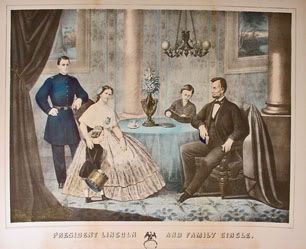
President Lincoln And Family Circle.
Respectfully Dedicated To The People Of The United States
Lithograph by A. Hohenstein.
Published by John Smith, 1865.
18 5/8 x 24 3/4.
[An interesting anecdote is that this lithograph was after a painting of Lincoln and his family by Francis Bicknell Carpenter, where he is reading to his son Tad. In Hohenstein's lithograph, Tad reads to his father.]

Franklin D. Roosevelt, Eleanor Roosevelt, and family
In Washington D.C.
June 12, 1919
(Picture courtesy the Franklin D. Roosevelt Library)

The Truman Family
By Greta Kempton
1952

The cut-off point for formal turning to casual seems to be the late 1950s. The reasons for this are complex, although they are mostly to do with the decline in authority and hierarchy in modern life, which brought forth the tumultuous 1960s. The Truman family portrait of 1952 subtly shows this change, where despite the parents' still formalized presentation, the young member of the family, the daughter, is sitting casually perched on the arm of her mother's chair.

The 1959 family portrait of Vice President Nixon has his younger daughter Julie leaning on her sister Tricia, with her arm draped around Tricia's shoulder. And rather than placing her hand on her father's arm, she seems to be clutching on to it. This is very different from the gentle hand President Roosevelt's son places on his father's shoulder, or even the soft placement of Margaret's hand on the back of the chair. Still, while Julie is less restrained, all the rest are sitting upright. Perhaps such informality can be allowed for a young child. A later portrait, with the daughters as grown young women, shows the family in a more formal air (despite those 1960s mini-skirts).

Vice President Richard Nixon and his family, 1959

President Richard Nixon and his family, 1969

The sprawling, informal family portraits began with the Kennedys' 1962 Christmas photo, where the extended family, which included Jacqueline Kennedy's sister and her family, were part of the unofficial portrait that was available for the public. Previously, portraits were of the nuclear family: parents and children (without their spouses). And family members were carefully positioned to compose a structured tableau. Was it the catholic nature of the Kennedy family that allowed this departure from tradition?

The Reagan, and especially the Bush, families follow this example of extended family inclusion, albeit with somewhat more formal photographs.

President John F. Kennedy and First Lady Jacqueline Kennedy
on Christmas Day at the White House Dec. 25, 1962.
Caroline Kennedy, John F. Kennedy Jr. , Anthony Radziwill ,
Prince Stanislaus Radziwill, Lee Radziwill, Ann Christine Radziwill.
(John F. Kennedy Library/ Getty Images)

A later Kennedy "family portrait" is even more casual, where instead of the formal interior setting of the White House, the Kennedys posed at the porch of their Cape Cod vacation home, where Jackie is in a summer dress, and President Kennedy is in jeans and a shirt with the sleeves rolled up.

The Kennedy family at their Cape Cod vacation home,
Hyannis Port, August 4, 1962

This is perhaps one of the first photographs of children clutching at their mother which we will see in an exaggerated and inelegant form in the Obama photographs. But, Caroline seems to be holding on to her mother to avoid tumbling off her somewhat unstable perch.

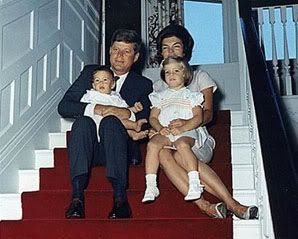
The Kennedys also posed in an informal manner sitting on stairs for a Christmas card family portrait, to have been released in December 1963, but which was cancelled after President Kennedy's assassination. Little John Kennedy is bare foot, and is held tightly (and somewhat clumsy) by his president father. The photo is endearing, but still I wonder at the (uncomfortable) casualness of it all.

A never-released Kennedy family portrait from 1963,
photographed just before President Kennedy's assassination

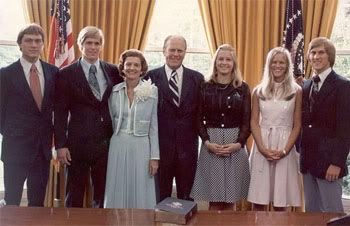
Portraits where all the protagonists are standing were rare in the past. I think that such portraits are imposing, especially if there is a large number of people. They are not necessarily formal. I'm not sure why this "tradition" started, and it seemed to have been initiated by the Fords, and later on followed by the Reagans.

A family portrait of Gerald Ford's family in the White House in 1974
Left to right:
Son Steven Ford, son John Ford,
First Lady Betty Ford, President Gerald Ford,
daughter Susan Ford,
and daughter-in-law Gayle Ann Ford
and her husband, Michael Ford.

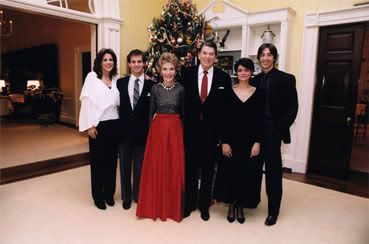
The Reagan family also opted to stand for their Christmas photo in 1983. Despite the "extended" family of children's spouses, with only two children and no grandchildren, this portrait is less of a sprawl compared to the Kennedy portrait.

Reagan family Christmas portrait, December 25, 1983

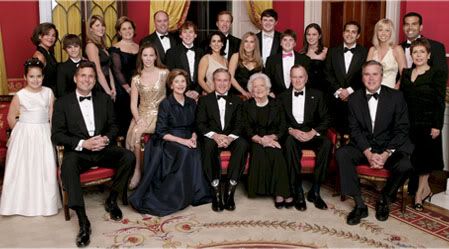
A sprawling Bush family portrait, which still has a formal air, includes:
President George W. Bush, first lady Laura Bush, former first lady Barbara Bush and former President George H.W. Bush sit surrounded by family in the Red Room of the White House January 6, 2005 in Washington, DC. Friends and family joined former President Bush and Barbara Bush in celebrating their 60th wedding
A 2005 Bush "extended" family portrait

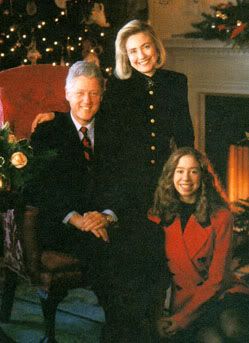
The Clintons avoid chaos in numbers in their family portraits because there is only three of them. Yet, Chelsea is too old to be sitting at her parents' feet (and wearing such a short skirt), and Hillary opts to perch on the chair's arm. These casual interjections distract from their well-groomed appearance. It's as though they want to contain casual and formal in one photograph.

Clinton Family Portrait, 1993

And finally to the clutching Obamas:

Obama Family Christmas card, 2006

The caption reads:
Happy Holidays [not Merry Christmas]
Wishing you and your family all the joy of the holiday season [no mention of Christmas, again. "Holiday season" uncapitalized...] and the hope that the New Year brings ["New Year" capitalized].
Barack, Michelle, Malia and Sasha [we are on first-name basis with the president].
Obama family portrait, 2009

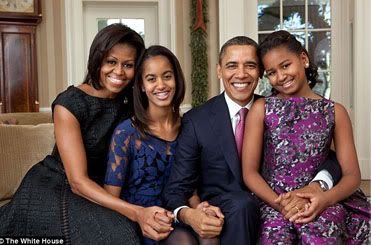
Just released Obama family portrait, 2011

The Obamas have released their family portrait, two years after their last one. I blogged about their 2009 portrait here, where I ask:
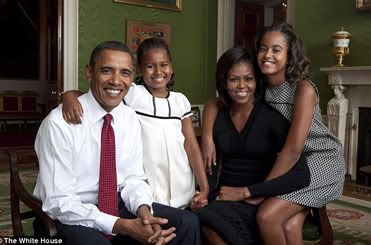
Why does Michelle allow her daughter to wrap herself around her like that?
I found the "wrapping around" odd behavior, despite the relaxed, family-oriented rather than formal, intent of the photograph. But, the collection of other presidential family portraits I've posted above, and even in the most casual shots, have a certain formality and decorum.

I continue:
What kind of daughter anyway (except for these self-conscious "low-self-esteem" types, who are always looking for attention) behaves like that?
I try to answer the question thus:
I think Michelle must be a distant, and not very affectionate mother, for all the talk she does about her daughters. And I think that Malia has to seek that affection.
In any case, irrespective of any psychological dynamics that go on within their house, many people avoid bringing them to the outside. Such an onus is especially placed on the First Family. Granted, modern-day presidential privileges are few, or tainted, such as having images of the couple and its family get taken at the oddest moments. But, such an adroit person as Michelle Obama surely could handle these difficulties. As I showed above, families with deep internal difficulties, including even the Clintons, often put on a brave and solid face before the public. The Obamas seem to just "let it all hang out."

Read More...

Saturday, November 19, 2011

Throwing Out Ornament

Right: The new Ryerson University Image Arts glass box all lit up
Left: The cloister windows of Notre Dame of Paris


I walk by Ryerson University almost daily in order to get to and from the downtown amenities (stores, bank, subways, etc.). Yesterday evening, I saw a young man taking photos of the new Image Arts building. I asked him what attracted him to the building. He said he liked the simple square. The building in the evening is impressively lit, and glows in dark shades of blue and yellow. Other times, it lights up in fluorescent pinks and purples. I'm not sure if this lighting extravaganza is to honor the new building, or if it will continue regularly. In any case, for a building that calls itself image arts, it is a cheesy decoration. But, it accentuates the box-like structure of the building.

I asked this young man if he's a film or photography student. He said neither, but was studying to be a counselor for LGBT youth. "Lesbian---Gay---Bisexual---Transgender---Youth" I said. Yes, he answered.

I asked him if architecture hadn't regressed. "Think about the medieval cathedrals, or the renaissance palaces. All we do now is glass boxes. Lego for grown ups. We're back to simple squares and circle, just a little above the line in the sand drawn with a piece of stick."

He informed me of the level modern technology has reached in order to build an almost exclusively glass building, since the glass is now essentially as strong as concrete.

Yes, but we have lost art in the process. Also, the medieval stained glass windows were no less of a technical feat. Their designers had to work with coloring the glass, designing the shapes, figures and forms within the glass, and making it function as a window. Think of the beauty of the glass in Notre Dame Cathedral. And the strength of those windows which held up arches.

I'm not into ornamentation, he replied nonchalantly, referencing (I think, although I may be giving him too much credit) the early twentieth century anti-ornament movement.

I don't think he's been to Paris, or even bothered with the history of glass and glass structures, when he gave me his quick, empty response.

"So what do you do" he asked me. I said I'm a former image arts (Ryerson) student of film and photography and that I tell people like him, one person at a time, that modern art, for all its supposed sophistication, has done us a great disservice, and is slowly dismantling our art and culture. And that my task as an image maker is to revive the tradition of the arts (of the image arts), and pick it up where modernism has thrown it aside, scornfully rejecting thousands of years of wisdom and erudition.

"Good bye, I have to be off now!" I said. Less than a minute later, I heard him shout from the (now empty) skating rink in front of the building: "I'm off too!" I hope he meant that he was done with those photos. Perhaps he just needed someone to jolt his intellect a little. I waved back, and walked on. But someone who has embraced this contrary life, this anti-life, is hardly going to be influenced by a five minute conversation. What he wants is the ultimate destruction of the traditional and religious society that condemns his "lifestyle." The less powerful this tradition, and its concrete reminders, the better for him and his ilk. Juvenile, even infantile art of basic shapes and design will certainly help with that regression, and ultimate destruction. One step at a time towards the gotterdammerung.

Read More...

Monday, August 29, 2011

The Chinification of Karlie Kloss

The Chinification of Karlie Kloss

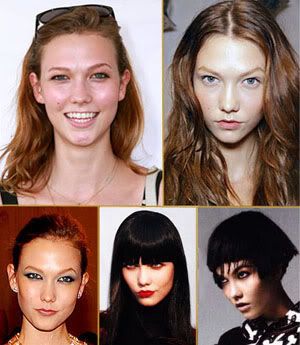
Karlie Kloss, an American fashion model who is highly in demand these days, is transformed from a fresh-faced mid-western girl with a genial smile into an anorexic Vogue fashion face who looks Chinese. Her blue eyes have morphed into dark slits, her wavy reddish-blond hair has darkened into a black mop, and even her complexion has changed ("yellowed"?).

Admittedly, she is a bit of a chameleon. Here she looks like Lauren Bacall, and here a charmless Brigitte Bardot. But better Bacall or Bardot than a Bing Bing.

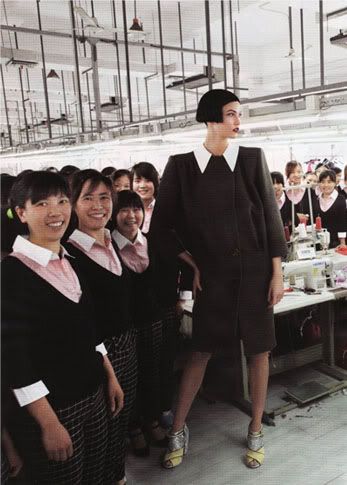
Karlie Kloss at the Eve NY garment factory in China
wearing a $2,570 Miu Miu double-faced wool coat

(From Sept 2011 Vogue)

--------------------------------------------------------------------------

The September 2011 issue of Vogue (curiously silent about September 2001, it is after all the tenth anniversary) has this on its cover:
"Made in China: The explosive rise of a style superpower"
I was genuinely interested to see what fashion designers and models there are in China. But it turns out there are none, at least according to this Vogue issue.

There are 22 pages dedicated to fashion in China, with nineteen of those in images (here is a blog which has posted all the images). But "fashion in China" turns out to be an elusive term. The model (there is only one) is the American blue-eyed, blonde-haired Karlie Kloss, who has been given the "Asian" look with dark straight hair (it looks like a wig, but that may be the point), her high cheek bones emphasized with careful coats of blush, and her eyes slanted with the help of eye-liner and other make-up tricks. And all the designers are Western, from the American Michael Kors to the British Stella McCartney (but Vera Wang doesn't figure amongst this illustrious group).

There is a parade of Chinese "cultural icons," such as film director Lu Chuan, actors Daniel Wu and Bing Bing, "novelist, race-car driver and renowned blogger" Han Han, and jeweler Bao Bao Wan, who are photographed alongside Kloss. Even the diminutive workers at the Eve NY sweat shop are presented as iconic figures, despite the 5"11 Kloss looming beside them. And her Miu Miu "double-faced wool coat (at $2,570)" resembles their white-collared uniforms. All of Karlie's clothes take reference (in color or in concept) from these "iconic" Chinese.

The locations for these photo shoots are also iconic landmarks : the Great Wall, the Pangu Plaza in Beijing, a sweat shop, in the Forbidden City.

Kloss has already appeared in the August 2010 and May 2011 issues of Chinese Vogue, so it is apt that American Vogue should solicit her help with their China-based article. After all, she is now the Western expert on all things Eastern.

The title of the Vogue article says it all: Go East. This is of course after the famous quote "Go West, Young Man," where going West meant adventure, discoveries, and even wealth (gold, land, etc.). But what does going East do for us now, and especially if it is a young woman (a fashion model at that) who is leading the way?

Western cultural guardians better be careful. The Chinese are not admiring our culture as much as finding ways to take from it, and there is more to take from us than they are able to give. They take our elaborate and sophisticated ideas and throw back at us their cheap and inferior "Made in China" versions. Before we know it, we will all be Chinese.

Read More...

Sunday, August 21, 2011

Multi-Culti Homosexuals and Lesbians


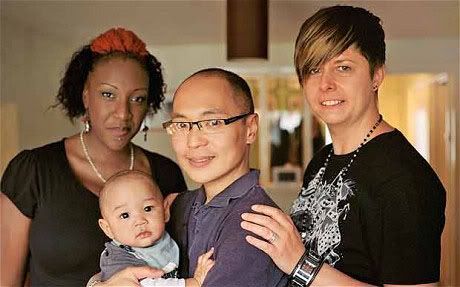
Here is an image, via View From the Right (from The Thinking Housewife, under the title "Portrait of a Family") which shows a black/white lesbian couple, with an Asian homosexual sperm donor, and the Asian-looking offspring.

Of course, there is a lot that is horribly wrong with this, as both writers have shown.

What struck me about this "portrait" is the expressions of the three adults.

The black woman looks uncomfortable, as though she's listening to, and following, some command which she does not want to obey, but has no choice in the matter. Why? Can't she delve into some inner morality of hers, dig out those sermons and Bible quotes that she surely must know, and act accordingly? Why are people having such a hard time following moral codes? I think the modern Church, society, culture, civilization, have failed such people, who have only pop culture and T.V. shows to turn to, and which makes them susceptible to aggressively immoral beliefs which they cannot tackle with their deficient systems. Of course, an obvious question would be why she couldn't find a black man, a black husband, to make a normal family with. I think black women have beaten down (or spoilt - just the other side of the coin) black men so much that even a few good black men are hard to find. Instead of being bitter, and turning lesbian, this is the time to rebuild that culture, not to destroy it further.

The white, butch-looking woman looks strangely satisfied with this menage she's acquired. She has no qualms about her "situation." Her protective hand over the Asian man shows she will be there to defend it all. She stands tall and proud, guarding her "family."

The Asian man looks shell-shocked but happy. He is the center of attention, along with the baby which he's "fathered." It is ironic that this lesbian couple would put a man as their focal point (in this picture, at least). But, he's not really a man, being a deviant homosexual. He seems less certain than the butch woman, but a little more stubborn (in his thoughts and ideas) than the black woman. The women have conceded to him holding the baby (because he's the "father," because he'll have to give it up soon anyway?). It makes sense aesthetically (photographers have a tendency to think in those terms), since it looks more (just) like him.

There was a time when we would run away, no, cast out, such freaks from our societies. Now, they get to pose for national newspapers.

And the baby's name is significant. For one, it is the name of a slave girl in a Turkish Sultan's harem in Mozart's unfinished opera of the same name. Here is a synopsis of the opera:
In Turkey, the Sultan Soliman has European slaves in his seraglio (Das Serail, the alternative title); two of them, Zaide and Gomatz, are in love, but the complication is that Soliman also has his eye on Zaide. The lovers ask their overseer Allazim (who is also a slave) to help them escape, and he eventually agrees to provide a boat for them. In Act 2 the runaways are brought back to face the Sultan's wrath. Allazim is also put in chains, but he tells Soliman that he once saved his life: as the commander of a Venetian ship he rescued Soliman from pirates, but he himself was taken into slavery. Allazim is pardoned immediately, but the Sultan is deaf to his plea for the escapees. And that is where it ends! However, an ending is provided on the recording I have (Orfeo 1983): Allazim inspires Soliman to show compassion, and the Sultan releases them, saying, "not only Europe, but also Asia can produce virtuous souls".
But I doubt that this mother has any love for Western culture, and least of all for a classical Western composer like Mozart. And would she even know about this relatively unknown opera? She'd rather give the baby a foreign-sounding, exotic name, burdening it with one more oddity it has to grow up with: A name which she believes has no real resemblance to the British culture it was born into. But at the rate things are going there, such "oriental" sounding names will be the norm, and "families" like this are making sure it will happen sooner than later.

But did Mozart get it wrong? Is the name for a female or a male? Searching on the web, I found several sources that translate Zaide as a Yiddish grandfather. Here is one:
Zayde/zaide (n.)
Grandfather: My zayde taught me how to throw a baseball.
But there are others which translate the name as Jewish for male or female elder. Other sources give the name Arabic origins (surplus, to grow), so it could be both male or female in Arabic also. Mozart's Zaide, which one would assume is a Turkish slave, is actually a European slave according to various write-ups of the opera, and this must be a euphemism for a European Jew in Mozart's era. So much for naming a baby.

Read More...

Tuesday, July 19, 2011

Delicate Portrait, Resilient Leaders

Drawing of Haile Selassie, 1959
By Afewerk Tekl
Charcoal
30 cm X 25 cm


Afewerk Tekle [1 2,] is an Ethiopian painter, who is best known for his stained glass windows in the Africa Hall of the United Nations Economic Commission for Africa in Addis Ababa.

Recently, I came across postcard reproductions of a few of his works. The first (above) is a delicate charcoal drawing of Haile Selassie, which Tekle describes as "Study for the portrait of the Emperor Haile Selassie" which he drew in 1959. Haile Selassie was around 67 years old then, but his face has an optimistic youthfulness. Before he decided to work as an artist, Tekle had gone to England to study mining engineering. At his departure (and probably with a large group of other young students), Haile Selassie told them: "You must work hard, and when you come back do not tell us what tall buildings you saw in Europe, or what wide streets they have, but make sure you return equipped with the skills and the mindset to rebuild Ethiopia." This was advice given by no means belittling Europe, but a way to remind these young Ethiopians that their task was bigger than admiration, but also learning and emulating.

The second (below) is a stained glass window in one of the military schools titled: "Great Leaders: dedicated to great kings who have defended Ethiopia against foreign military intervention." It is a much larger 6m X 4m, and dates back to 1958. It is hard to read the script at the bottom of the figures and worse on the blog, but the first (on the left) is Emperor Menelik II (Dagmawi Menelik), and the second is Ras Makonnen, father of Haile Selassie. The fourth figure with the crown is most likely King Ezana (I can clearly make out the "E" and somewhat the "Za" from "E", "Za" "Na" of the three letters of his name in Amharic):


Great leaders: dedicated to great kings who have defended
Ethiopia against foreign military intervention, 1958
By Afewerk Tekle
Stained glass window in Harar Military Academy
6 m X 4 m


-----------------------------------------------------------

References:
1. Afewerk Tekle on Wikipedia
2. Afewerk Tekle on facebook (a more extensive biography)

Link:
The Lion of Judah

Read More...

Friday, July 15, 2011

Michelle and a Shovel


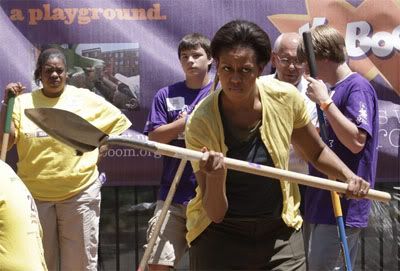
There is a blogger who goes by IMAO (In My Arrogant Opinion) who gets his readers to add captions to images he puts out. One of his readers came up with the caption above. I think just "Shovel Ready" would have been enough.

But IMAO's readers are not the only one to notice the shovel link. When I Googled: Michelle Obama Shovel, I got pages of Mrs. Obama hard at work.

Here is the actual image that is making the rounds:


A reuters caption describes what she is doing:
U.S. First Lady Michelle Obama holds a shovel as she joins volunteers to build a playground at Imagine Southeast Public Charter School in Washington, June 15, 2011.
If you can bear to look, here is Mrs. Obama on a swing meant for young children, which she had just finished installing at this same school (scroll down for the image).

Read More...