Showing posts with label Language. Show all posts

Saturday, September 01, 2012

L'Heure Bleue


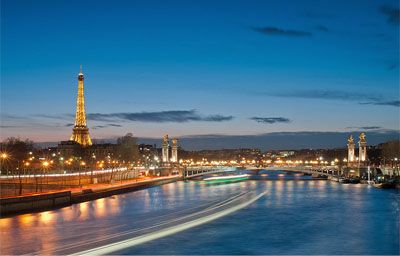
I posted in my previous post an image of the Seine at "L'Heure Bleue" without explaining the meaning of the term.

From Wikipedia:
The blue hour comes from the French expression l'heure bleue, which refers to the period of twilight each morning and evening where there is neither full daylight nor complete darkness. The time is considered special because of the quality of the light at this time of day.

Wikipedia continues with a more metaphoric meaning:
The phrase is also used to refer to Paris immediately prior to World War I, which was considered to be a time of relative innocence.
The Wikipedia site has other interesting pieces of information, including art, books, films and music which use l'heure bleue.

It is a hard moment to catch. It is not quite light, not quite dark, with a strange sense of stillness. A little like the moment of a full solar eclipse, when the earth seems momentarily to be at a standstill (I have seen a full one in 1991 in Mexico City, of course through safety glasses. One thing that struck me was the birds stopped chirping - I was near a wood - for those brief seconds).

Read More...

Thursday, July 12, 2012

Summer Reading

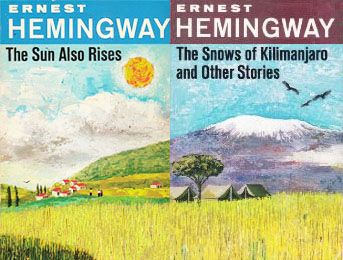
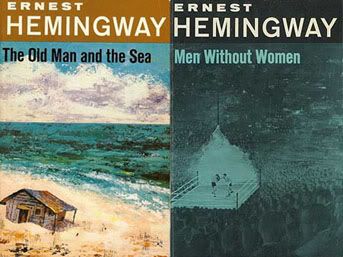
Cover illustrations by James and Ruth McCrea

Summer is a time when I do most of my fiction reading now. Below is an unpublished blog I did on Ernest Hemingway a couple of years ago. I don't know why I didn't post it, except that I was hoping to do more of a literary critique of his books, and especially of The Sun Also Rises, which I recently started to re-read, marking the pages that affected me. The Sun Also Rises was one of my favorite books when I was in university - in graduate school to be exact - when I was was studying endless scientific research papers to fine tune my thesis. I would read just a few pages of the lovely script before embarking on journal articles. If I read too much, that would be the end of my "serious" studies, and I would spend the rest of the time on the book.

Here's what I wrote in my unpublished blog:
Summer Reading

Hemingway was a favorite of mine, back when I used to carry fiction books with me wherever I went. I don't do that as much now, but I do keep up with my fiction reading. I’m often re-reading older classics. Jane Austen's Emma and Tolstoy's Anna Karenina are perennial favorites. Contemporary fiction writers leave me unsatisfied. I can see their talent (of the talented ones, that is), but their stories are imbued with their personalities, as though they cannot shake off their egos as they write. Their stories also have macabre, strange, or nihilistic endings, and I come away bewildered or depressed.

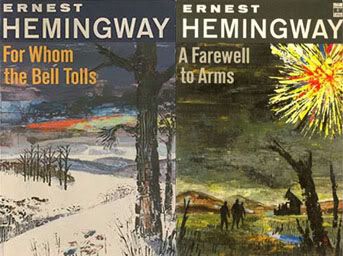
Cover illustrations by James and Ruth McCrea

I've read four of Hemingway’s books: The Sun Also Rises, A Farewell to Arms, The Old Man and the Sea and For Whom the Bell Tolls. And his collection of short stories: The Snows of Kilimanjaro and Other Stories and Men Without Women. I'm not a literary critic, so I don't really know how to start analyzing Hemingway's writing - it's already been done ad infinitum anyway by experts and laymen alike. But, his stories are accounts of unrequited love in many ways. The characters, which he brings to life so clearly, are very modern people who enter all kinds of debacles, yet they come out surprisingly pure and unblemished despite their weaknesses and failures.

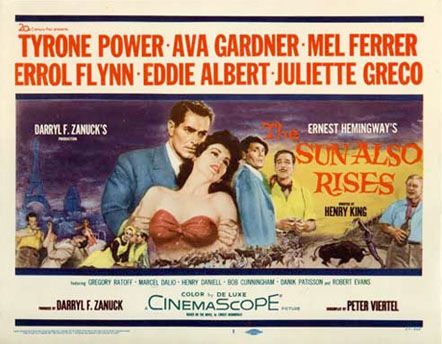
Tyrone Power, Ava Gardner and Eroll Flynn
in a 1957 film adaptation of The Sun Also Rises
Directed by Henry King

King also directed Ava Gardner in 1952 in
The Snows of Kilimanjaro, another Hemingway adaptation
Cover illustrations by James and Ruth McCrea

What surprised me reading Hemingway this time around are the long, unending sentences that Hemingway uses at times, producing an almost trance-like meditative quality. This goes against the hard simplicity of his prose that many analysts have described about his writing. His description of places, whether it is a café in Paris or the Spanish (and Italian) countryside resonates in my mind – always has – and urges me to visit these vivid locales.

[End of original (unpublished) blog entry.]
Here's an excerpt from The Sun Also Rises as Jake Barnes, who is the narrator and protagonist, describes their entry into Spain:
Then we crossed a wide plain, and there was a big river off on the right shining in the sun from between the line of trees, and away off you could see the plateau of Pamplona rising out of the plain, and the walls of the city, and the great brown cathedral, and the broken skyline of the other churches. In the back of the plateau were the mountains, and every way you looked there were other mountains, and ahead the road stretched out white across the plain going toward Pamplona.

[Hemingway, Ernest. The Sun also Rises. New York: Charles Scribner's Sons, 1954. pp. 93-93]
But looking at the stamp in my (worn) The Sun Also Rises, I find this:
Paper Back Junction
343 East Main Street
Lock Haven, PA 17745
So I was a fan of Hemingway even as an undergraduate in the small Pennsylvania college where I was a busy biology student!

The first pages of the book has these two quotes:
"You are all a lost generation"
- Gertrude Stein in conversation

- "One generation passeth away, and another generation cometh; but the earth abideth for ever...The sun also ariseth, and the sun goeth down, and hasteth to his place where he arose...The wind goeth toward the south, and turneth about unto the north; it whirleth about continually, and the wind returneth again according to his circuits...All the rivers run into the sea; yet the sea is not full; unto the place from whence the rivers come, thither they return again."
- Ecclesiastes
The nihilist, modernist, Stein is juxtaposed with a biblical account of the fullness, continuation and eternity of God's creations and of life. This odd, disconcerting juxtaposition is partly what makes The Sun Also Rises a masterpiece: people never quite give up on life, and on love, despite the devastations many have been through.

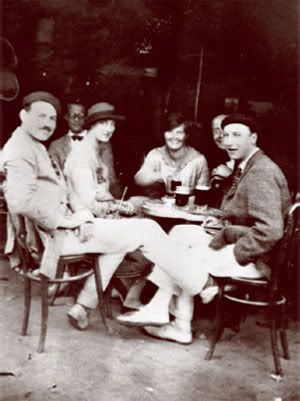
Below is a photo of Hemingway in Pamplona in 1925, which I blogged about here. Hemingway first edition of The Sun Also Rises was published in 1926.
Left to right Ernest Hemingway with Lady Duff Twysden,
Hadley Hemingway, and three unidentified
people at a cafe in Pamplona, Spain, July 1925.

[Photograph in the Ernest Hemingway Photograph
Collection, John F. Kennedy Presidential Library
and Museum, Boston.]

Read More...

Wednesday, June 20, 2012

Heroin, Simply

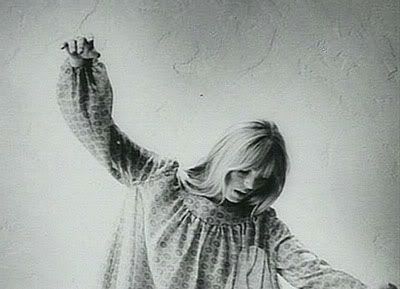
Nico, there she goes again

I wrote in my previous blog post There He Bows Again, about President Obama's various bends from around the waist area down, that the title for the post (which I got from a Drudge headline) reminded me of a Velvet Underground song "There She Goes Again." The song is supposedly about the song writer's (Lou Reed's) heroin addiction (according to the lyric translating experts). I begged to differ and thought it was more straight forward than that, and was actually about the woman (she) protagonist asking her lover for a second chance.

Well, the Velvet Underground has no qualms about writing directly about sordid subjects, and actually has a song titled..."Heroin" (without the "e"). Below are the lyrics. I don't mean to be deliberately antagonistic by quoting all the lyrics, I just mean to show that people really do write about ugly things like drug addiction, as though it were some romantic experience:


Heroin
Velvet Underground

I don't know just where I'm going
But I'm gonna try for the kingdom, if I can
'Cause it makes me feel like I'm a man
When I put a spike into my vein
And I'll tell ya, things aren't quite the same
When I'm rushing on my run
And I feel just like Jesus' son
And I guess that I just don't know

I have made the big decision
I'm gonna try to nullify my life
'Cause when the blood begins to flow
When it shoots up the dropper's neck
When I'm closing in on death
And you can't help me not, you guys
And all you sweet girls with all your sweet talk
You can all go take a walk
And I guess that I just don't know

I wish that I was born a thousand years ago
I wish that I'd sail the darkened seas
On a great big clipper ship
Going from this land here to that
In a sailor's suit and cap
Away from the big city
Where a man can not be free
Of all of the evils of this town
And of himself, and those around
Oh, and I guess that I just don't know

Heroin, be the death of me
Heroin, it's my wife and it's my life
Because a mainer to my vein
Leads to a center in my head
And then I'm better off than dead
Because when the smack begins to flow
I really don't care anymore
About all the Jim-Jim's in this town
And all the politicians makin' busy sounds
And everybody puttin' everybody else down
And all the dead bodies piled up in mounds

'Cause when the smack begins to flow
Then I really don't care anymore
Ah, when the heroin is in my blood
And that blood is in my head
Then thank God that I'm as good as dead
Then thank your God that I'm not aware
And thank God that I just don't care
And I guess I just don't know

Read More...

Monday, April 23, 2012

La Vie en Rose pour Edith et Louis

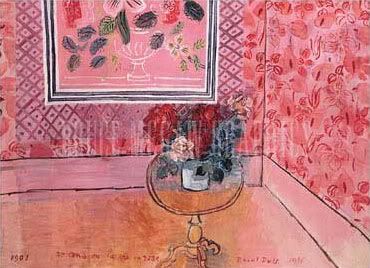
Trente Ans ou La Vie en Rose, 1931
By Raoul Dufy (1877-1953)
Oil on canvas
Musée National d'Art de Moderne in Paris, France

[See notes on the painting below the lyrics]


---------------------------------------------------------------------------------------------------

Edith Piaf and Louis Armstrong
"La Vie en Rose"


I recently heard Edith Piaf's lovely song "La Vie en Rose" on the radio, with Louis Armstrong singing it in his inimitable voice. He sings mostly in English but endearingly tries a little French along the way, mostly in the refrain "La Vie en Rose" where his rose sounds more American than French. Another "Armstrong" variation is when he adds the letter "n" in the French "en" and pronounces it "en" as in "end" without the "d" (the correct pronunciation of "en" is at the 1:06 spot in this French pronunciation video).

Below are videos of Armstrong and Piaf singing "La Vie en Rose" (Armstrong also plays the trumpet):

Edith Piaf singing La Vie en Rose

Louis Armstrong singing La Vie en Rose

Lyrics to La Vie en Rose:

Des yeux qui font baisser les miens
Un rire qui se perd sur sa bouche
Voilà le portrait sans retouche
De l’homme auquel j’appartiens

Quand il me prend dans ses bras
Il me parle tout bas
Je vois la vie en rose

Il me dit des mots d’amour
Des mots de tous les jours
Et ça me fait quelque chose

Il est entré dans mon coeur
Une part de bonheur
Dont je connais la cause

C’est lui pour moi, moi pour lui dans la vie
Il me l’a dit, l’a juré pour la vie

Et dès que je l’aperçois
Alors je sens en moi
Mon coeur qui bat

Des nuits d’amour à plus finir
Un grand bonheur qui prend sa place
Les ennuis, les chagrins s’effacent
Heureux, heureux à en mourir

Quand il me prend dans ses bras
Il me parle tout bas
Je vois la vie en rose

Il me dit des mots d’amour
Des mots de tous les jours
Et ça me fait quelque chose

Il est entré dans mon coeur
Une part de bonheur
Dont je connais la cause

C’est toi pour moi, moi pour lui dans la vie
Il me l’a dit, l’a juré pour la vie

Et dès que je l’aperçois
Alors je sens en moi
Mon coeur qui bat

About painting above, "Trente Ans ou La Vie en Rose" by Raoul Dufy:
Trente Ans ou La Vie en Rose (30 Years or Life Through Rose Colored Glasses)

Raoul Dufy took thirty years to paint ‘Trente Ans ou La Vie en Rose’, hence the title for this composition. The painting is also known as ‘La Vie en Rose’ which can be interpreted as “The Rosy Life” or “The Sweet Life”.

Flowers, flowers everywhere! The small bouquet that sits in a vase on a corner table is somewhat replicated in the painting that hangs behind it. The walls seem to scream sweetness and happiness with their varying wallpaper designs, two of which are flowers, the whole in soft and hot pink tones, including the baseboards. Dufy’s inspiration for the wall décor most likely comes from his experience in fabric design and interior decorating.

The artist’s intention, with regard to this painting, was to depict all the good things that life has to offer, ignoring any pain or strife that often interrupts its flow, as implied in its English title, ‘Life Through Rose Colored Glasses’. The overall aspect of ‘Trente Ans ou La Vie en Rose’ appears simple, yet it is intricate in its meticulous details. Dufy added the title, his name and date at the bottom of the canvas.
Critique of the painting:
The artist adapted the creative use of color and drawing exemplified by Henri Matisse and the Fauve movement, but added a heightened ambient light to achieve the brightness that became an integral element of his work.
– W.Scott Bailey U.S.A. Today

On Dufy:
It was only after the war that he (Raoul Dufy) found his own personal style, producing rapid but precise drawings of frequently plunging perspectives, to which clear colours are applied with a kind of casual freedom. His favourite subjects are regattas, casinos and palm trees, race courses and orchestras, but his representations of the southern towns of Avila and Caltagirone are imbued with equal charm.
- From “ART20, The Thames and Hudson Multimedia Dictionary of Modern Art”

Read More...

Wednesday, December 21, 2011

More on Chelsea Clinton's Name


As I tried to find a title for the Chelsea Clinton blog I posted, I went on an internet detective tour to figure out why the Clintons named their daughter Chelsea.

I thought of "Chelsea Lately" but it is the name of a pretty obnoxious late night show "comedian" Chelsea Handler. Then, I thought of "Chelsea Again" but Chelsea isn't that famous that she needs a comeback.

I thought the name might have to do with the once bohemian Chelsea neighborhood in New York City, which might fit the 1960s bohemian style of the Clintons when Hillary was a radical college student who wrote her thesis on Saul Alinsky.

The Clintons apparently did give their daughter her name from the Joni Mitchell song Chelsea Morning recorded in 1969, which was inspired by the Chelsea neighborhood where Mitchell lived when she composed the song, where she references the glass mobiles which made a "rainbow on the wall" of her apartment. It is a pretty song.

My blog story is really about how Chelsea is neglecting her home life and new husband, so I took the Barbra Streisand song Sadie Sadie Married Lady from the film Funny Girl. Apparently Sadie is a Jewish slang for a married woman. I cannot find further evidence for this, but here is an event, Sadie Hawkins Day, that evolved from an episode in the comic strip Li'l Abner and had became a real-life event. Sadie Hawkins Day is when spinsters of all ages "foot raced" bachelors to get themselves a husband.

In Funny Girl, the "Sadie" is Fanny Brice, a career (singing) girl who gets married, but doesn't give up the stage. Her less successful husband (whatever his reasons are, but could they be a neglectful wife?) gets involved in gambling debt and is sent to prison. Fanny in the end divorces this husband, and continues her show business life, becoming famous.

Barbra Streisand as Sadie in Funny Girl,
singing Sadie, Sadie, Married Lady

---------------------------------------------------------

Joni Mitchell singing Chelsea Morning in 1969

---------------------------------------------------------

Chelsea Morning
By Joni Mitchell

Woke up, it was a Chelsea morning
And the first thing that I heard
Was a song outside my window
And the traffic wrote the words
It came ringing up like Christmas bells
And rapping up like pipes and drums

Oh, won't you stay
We'll put on the day
And we'll wear it 'till the night comes

Woke up, it was a Chelsea morning
And the first thing that I saw
Was the sun through yellow curtains
And a rainbow on the wall *
Blue, red, green and gold to welcome you
Crimson crystal beads to beckon

Oh, won't you stay
We'll put on the day
There's a sun show every second

Now the curtain opens on a portrait of today
And the streets are paved with passersby
And pigeons fly
And papers lie
Waiting to blow away

Woke up, it was a Chelsea morning
And the first thing that I knew
There was milk and toast and honey
And a bowl of oranges, too
And the sun poured in like butterscotch
And stuck to all my senses

Oh, won't you stay
We'll put on the day
And we'll talk in present tenses

When the curtain closes
And the rainbow runs away
I will bring you incense
Owls by night
By candlelight
By jewel-light
If only you will stay
Pretty baby, won't you
Wake up, it's a Chelsea morning

Read More...

Monday, December 19, 2011

Calling Out Evil

Celestial Light?
[Photo by KPA]

I've noticed something.

People who indicate that they don't believe in evil (and hence, who fundamentally don't believe in the good - and in God) cannot say the word is evil. They just cannot say it. They even hate the word (said aloud, at least).

When pressed to explain evil, or find a word that describes/replaces it, they will search for synonyms like: poverty, bad luck, difficult childhood, lack of education/knowledge, oppressive society, [place your favorite version here].

Yet whatever good they see, or whatever good anyone tries to do, they attribute to some nefarious intent. A good or kind deed is to curry favors. A beautiful work of art is the result of oppression. Nature is destructive all its floods and earthquakes. People are not to be trusted.

So they do believe in evil! Actually, for them, evil is the only force in town. Their whole world is one big evil, to be carefully and studiously picked at, either to be outwitted, or to serve their own purposes.

But, if they believe in evil, they must also believe in (or at least acknowledge) good. So, good (God) is a force that has to be destroyed, or contained, since it is the only force which is capable of destroying their evil, their world.

They may genuflect, chant and purport to kneel before God, but they are only biding their time until they gain a sure upper had and can unleash their apocalyptic evil onto the world. Their bleak and terrible world of evil cannot (will not) be accepted by ordinary people, so they have to cajole and lie, to them until the moment is right, and ripe, for a full-on assault.

Our modern world is replete with these quasi-invisible, hypocritical, non-believers. It is disarming to see them rear their satanic heads when they are unable to contain their terrible secret. Sometimes it is with an unusually violent reaction (often with exaggerated words and tone) to an innocuous (good) statement or observation. Other times it is with a deafening silence with "NO COMMENT" emanating from their very pores, again at seemingly innocuous (and good) words. Yet other times, it is with insidious deceits, trying to pull in bystanders in this war against the good, and against God himself.

But most of all, these haters of the Good and of God hate hearing the word evil, and especially being called evil, because evil is embedded in their hearts and something which they secretly and shamefully harbor, which they know in moments of clarity (one can see stunned expression in their eyes when this realization takes place) is a nefarious force that will throw them down a never-ending abyss. Therefore, the biggest insult they can receive, the biggest fuss they make, is when someone calls them evil.

We need to call out evil, to get it out of the woodwork and into plain sight, where we can fight it.

Read More...

Sunday, October 16, 2011

Truth vs. truth

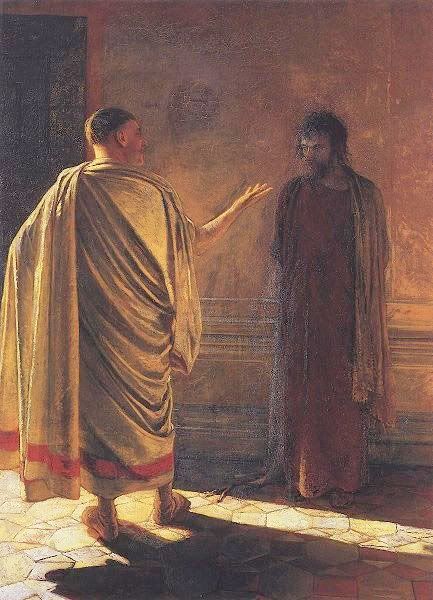
Quod Est Veritas? Christ and Pilate
By Nikolai Ge

In my ongoing attempt at understanding liberals, here is a thought:

Liberals are interested in truth, not Truth. And they are willing to lie to attain it.

Read More...

Tuesday, September 27, 2011

(Serious) Design Flaws of a Vera Wang Gown:
Or, How Vera Wang is a Mediocre Designer

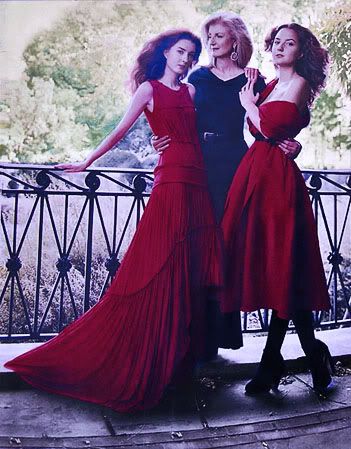
Arianna Huffington with her daughters
in the October 2011 Vogue
Left: Isabella in Vera Wang
Right: Christina in Prabal Gurung
Center: Arianna in Lanvin

Vera Wang's dress in the October 2011
Vogue, work by Arianna Huffington's daughter

Here's more on that much-touted, mediocre designer Vera Wang.

To the detriment of being called racist, I repeatedly find myself bewildered at the subtle ineptitude I find in "Asians" - the category in the West which now includes Chinese, Korean and Japanese (but probably a more accurate term would be East Asians, since South Asians includes the far different race of Indians, Bangladeshi and Pakistani, also from the Asian continent).

For example, I was in the bank yesterday, withdrew some money, and asked the teller for my balance. She wrote it on a piece of paper. I said I would prefer a print out, so that it is an official record. Her response was a mixture of lies (that I had already finished a transaction and the system had switched off), laziness (unwilling to log back into my account) and possibly ineptitude, the cause of which I haven't figured out other than if the system does shut down after a log off from a recent transaction, she doesn't know how to turn it back on for the same transaction. All this was communicated to me in broken English in a Chinese accent.

(As a side, but important, note, there is a huge influx of Chinese in Toronto these days. I think many are entering on "economic" and "education" immigration quotas. I think there is also a racial component to their ability to enter Canada relatively easily. Blacks and Muslims, and to a lesser extent Indians, appear to be more "different" than whites, so the Chinese are a better choice to fill the immigration quotas promised by almost all the political parties. Their contribution in both those areas are suspect, and I will provide some information, research and conclusions on these soon.)

Back to the Chinese teller. If I had been really difficult (I did throw back the scrap of paper at her after telling her it was unacceptable), I would have asked for her manager, reported her behavior, and indicated that this wasn't the first "lack of communication" that had occurred with Chinese tellers in the bank, who either: don't understand sufficient English to be tellers; or don't have sufficient training to be tellers. I suspect it is a combination of all the above.

This isn't an isolated incident. It happens at coffee shops, in department stores, even on streets where negotiating the sidewalk with Chinese pedestrians is a weird event where they seem to think that ceding the sidewalk space is the responsibility of the other person - something which I no longer do, with interesting effect.

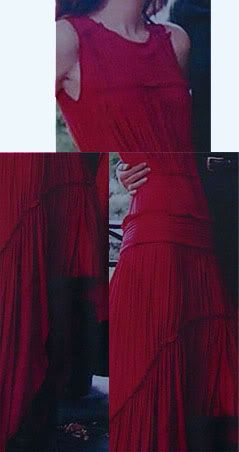
Back to Vera Wang. Above are the dresses from the October 2011 Vogue issue where she designed one of the dresses for Arianna Huffington's daughter, Isabella. (The other is by another "Asian" designer, Prabal Gurung, but more on him in a later blog post, but here is his odd, mediocre - there's that word again - Spring 2011 collection.) Below are close-ups of parts of Wang's dress, with my critique of what's wrong with the dress.


- The fabric: For a "flowing gown" which this dress seems to attempt to be, why use such heavy fabric, which rather than flowing seems to be dragged down by its own weight?

- The collar area: This shapeless, formless cut looks like a cheap, quick cut by a mediocre tailor.

- The gathering: These shapeless gatherings add nothing to the aesthetics of the dress. In fact, they make it look like some home-decor fabric, like a curtain.

-The waist: There is no distinct cut or shape for a waistline, other than a weird gather around the waist. The drop waist with a thick inelegant band makes the dress even more shapeless. Isabella is a thin girl, with very little of a waist. This dress gives her no figure, nor helps accentuate a waistline through cut or tailoring.

- The sleeves: Isabella's thin arms are dwarfed through the gaping holes that pass for sleeves. Longer sleeves, or some busy pattern even on these short sleeves, would have made her arms more attractive.

- The "train": For want of a better word, that's what the fabric dragging at the back seems to resemble. But what the dress looks like is a long gown with a piece missing in the front.

- The color: The red color has a blue tint. Red with a blue tint is cold and dark. Why not go for a more festive brighter red? After all, Isabella is only 21. I think color in design is a very important part, which often makes or breaks the design. Wang was unable to deliver in this category.

---------------------------------------------------------------------------------------------

Entries on Vera Wang at Camera Lucida:

- Vera Wang's Aggressive Asian Outreach: Part I, September 21, 2011
- Vera Wang's Aggressive Asian Outreach: Part II, September 21, 2011
- Vera Wang's Aggressive Asian Outreach: Part III, September 22, 2011

- Vera Wang vs. Amsale Aberra, August 9, 2011
- Wang's Wedding Dress Fit for a Vampire's Bride, August 24, 2010
- More Thoughts on Chelsea's Wedding, August 7, 2010
- Vera Wang: Wedding Dress Designer?, July 29, 2010
- Modern Bridal Wear, January 27, 2010
- The Global Runway: Part 3, August 4, 2006

Read More...

Sunday, August 07, 2011

Immigration and the English Language

I wrote recently about a couple of elevator incidents. In this one, I describe the strange Asian language that a family was speaking. (I can usually distinguish between the Chinese Mandarin and Cantonese and recognize when it is neither, and Vietnamese, since I spent some years teaching English as a Second Language at a Chinese immigration center.) The family is clearly new to the country, since even the children were speaking the language to each other. And children pick up English relatively quickly, school requirements and all.

But these children will most likely retain their strange accent. We can no longer go back to those charming quirks where Robert De Niro's "You talkin' to me?" can only sound effective in his Italianized American English. These accents are more alien, more persistent, and more widespread. I've already noticed that Chinese who look from a distance like they are "assimilated" Chinese Canadians speak a strange accented English with what I presume are Chinese grammatical influences, such as dropping the "s" at the end of plural words, or when speaking in the third person, as in "he speak."

This is deeper than an accent. It is a re-writing of the English language and creating a new idiom. Something like the pidgin English spoken by Caribbeans, which an Englishman would be hard pressed to understand.

Yet another colorful addition to our multi-culti smörgåsbord, which will quietly and efficiently do away with the beautiful English language.

Read More...

Saturday, July 23, 2011

"I’m an individualist, not a racialist"


Once in a while, I check up on ex-Canadian immigrant, ex-South African, libertarian, non-practicing Jew, columnist and author Ilana Mercer, who, in my humble opinion, has a mediocre writing style, which is full of jarring alliterations, although that is less so now. But she couldn't help a "by bombs and boycotts" in her latest blog post.

She is a writer at WorldNet Daily, although a while ago I noted that she was off their roster until she returned with somewhat subdued pieces. She was also part of that Alternative Right group, which ended up being an anti-Semitic site, and she hasn't written for them in over a year.

She writes on a recent post at her blog:

"I’m an individualist, not a racialist."

Then she proceeds to advertise her book, Into the Cannibal’s Pot: Lessons for America from Post-Apartheid South Africa, which is about how black-run South Africa is not working. Why conjure up the inflammatory image of a cannibal's pot? Why not find a clear-cut way of saying that black leaders are failing, and even destroying, South Africa, and are in danger of doing the same in America?

And even the book design, with black hand prints (it could be mud prints) soiling the white body of a naked woman, is not the neutral individualist's perspective she is trying to convey in her blog statement. It is aggressive and confrontational.

I'm not suggesting that Mercer tone-down the truth, but upping the ante with incendiary imagery, and race-loaded phrases, while talking the smooth talk of neutrality, is hypocritical.

I'm not sure why she needs to adamantly emphasize her individualism, since it is clear by now that her libertarian position informs many of her opinions.

But, of course, it is to contrast it with grouping people into racial categories, which to her is racialist, i.e. racist, which is the most evil thing a modern person can be. So she has antagonistically divided the world into racial groups, but she won't get her hands dirty and will remain the sacrosanct individual.

What we aspire most from writers, truth and discernment, becomes contradictions and in effect lies, when in the hands of writers like Mercer.

Read More...

Monday, March 14, 2011

Blacks' Viciousness Coupled with Incompetence

And getting thrown under the bus


Lisa Rinna said "they all threw me under the bus" about her black team-mates
on The Celebrity Apprentice.

Maybe we're getting new imagery and metaphor here. When whites are surreptitiously betrayed by blacks they felt they were close to, they were "thrown under the bus."

------------------------------------------------------------------------------------------

I try not to watch too much pop television, but these days there are enough shows to write a whole PhD thesis on.

Celebrity Apprentice, one of Donald Trump's signature "reality" shows, is the least entertaining, song and music-wise, so I don't usually bother with it. But for some reason, I tuned in this season.

What a revelation this season is.

Two teams are each divided into men and women. Each week, the teams choose their project leaders, who become part team leader, part CEO. Finding the balance can be tricky.

The teams work on assigned projects, and are judged by "professionals". The losing team has to fire a member, usually the project leader.

So far (week two), David Cassidy was eliminated from the men's team on week one. Cassidy wasn't the project leader, whose status went to the sleazy homosexual Richard Hatch, who was imprisoned for tax evasion of money he won at another "reality" show - Survivor. But, Cassidy was no match against Hatch.

And soap opera actress Lisa Rinna who was project leader for the women's team this week was "fired" last night, since her team failed to deliver a winning children's book, the assignment for that week.

There are four black females on the women's team out of a total of eight contestants. They are:

- Dionne Warwick - who knew an older, and one would have thought a wiser, woman, would throw such punches

- La Toya Jackson - her plasticized face looks even worse than Michael Jackson's

- NeNe Leakes - a left over from another reality show, The Real Housewives of Atlanta, and who was evicted from her "mansion"

- Star Jones - fired from The View. She was too much even for that liberal bastion

About Lisa Rinna: she had her lips "botoxed" to a ridiculous size a few years ago. Recently, returning to sanity, she had that procedure reversed, with a somewhat reduced pout. I doubt La Toya Jackson can ever revert to her original, normal state even if she wanted to.

There is one black male on the men's team again out of a total of eight. He is rap music "star" Lil Jon, complete with metal grills - rap "fashion" braces, usually in gold or platinum encrusted with diamonds - on his teeth .

As Lisa Rinna was getting fired, she made a short pitch saying she had never encountered such negativity from women before (with Trump saying "I understand", but "firing" her anyway), and she specifically named Dionne Warwick, La Toya Jackson, Nene Leakes, and Star Jones. Hmm.

Rinna handed over the "creative" parts of writing the story and designing the book to Star Jones and Dionne Warwick. The women's team subsequently lost, and Jones and Warwick attacked Rinna for their loss, saying that she "crumbled under the pressure." Rinna initially agreed. "Yes, I crumbled," she said, to mogul Trump. But fortunately, she still had some spunk left in her when these team players kept the accusations high. "You just threw me under the bus. You wanted me to fail, to get rid of me," were her final words to these "ladies".

It was actually the final product based on Jones's "creativity" and Warwick's "design" that lost the women's team its winning position. Rinna couldn't come out with this at the beginning. I think she felt she was walking on egg shells, trying not to hurt these super-sensitive black women's feelings, or worse, not to appear racist. And it was too late when she regained her spunk. I think she was just in shock at what she was experiencing. She finally let out full steam on her "twitter" page, "Star Jones=Alien Monster," and on radio shows.

And various entertainment news outlets are also reporting that things got "ugly" backstage between Rinna and Jones after the show. And lawyers have gotten involved. Good.

Rinna should be thankful she's out. All the other white contestants concurred with her statements, but were quiet and subdued, at least last night. Some did voice their shock at how Rinna got treated. I don't think they can work peacefully and cooperatively with their black team-members from now on.

What these clueless black women don't understand is that they've made a perfect case for avoidance by whites, employees and acquaintances, in the "real" world. Some shows have already learned this lesson. Case in point: Star Jones, Star Candidate for Barbara Walters's Liberal Love Fest got fired from The View after nine years on the show, and has never completely recovered. A black woman getting fired from The View is history-making! Appearing on Celebrity Apprentice is a definite fall from grace for her; a place where forgotten or discarded television personalities go to try and regain some foothold. But it hardly ever works.

Jones was recently fired from another entertainment show, the second-grade The Insider. Here's the report:
The former View moderator has been ousted from her position as a panelist on the syndicated celebrity newsmagazine after sparring with a show producer over creative differences, according to a new tabloid report. Production insiders say Jones found herself in the middle of a verbal spat with a superior that nearly turned physical and led to the outspoken chatterbox being led out of the studio by security.
Rinna left the Apprentice premises quietly, and I thought with dignity, trumping those women who humiliated her (Donald Trump, take note). She came out the winner in the end.

Read More...

Tuesday, March 08, 2011

Onward!

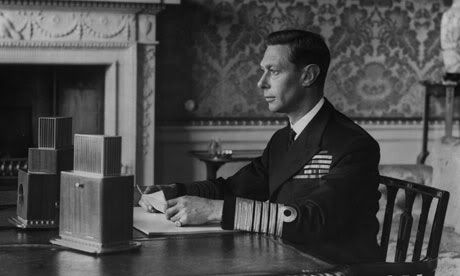
King George VI after delivering his speech on
September 3, 1939, after Britain's declaration of war
against Germany.
[Photograph: Hulton-Deutsch Collection/Corbis]


"If I am to be King...where is my
power? May I form a Government,
levy a tax or declare a war? No!
Yet I am the seat of all authority.
Why? Because the Nation believes
when I speak, I speak for them. Yet
I cannot speak!"


"Through his broadcasts, George VI
became a symbol of national resistance."


"Onward!"

I took notes (in the dark) while watching The King's Speech. I had already seen the movie once, and came prepared with pen and paper (actually, a notebook) to write down quotes, impressions, dialogs, scenes, set design, etc. I especially tried to link image with dialog, and with sound - there is a subtle, delicate, link between sound (mostly music) and image. At the end credits, my recognition of the sound's quality was rewarded when I learned that Alexandre Desplat composed original music for the film. I had already encountered Desplat's music for Roman Polanski's 2010 film The Ghost Writer, and how well it connected with the images.

I thought it would be interesting to reproduce these notes on my blog, to provide some insight on the film's construction, at least working backwards from the finished product.

Below are the notes, more-or-less in chronological order.
--------------------------------------------------------------------------------------


- King's speech in front of crowd at the Empire Exhibition in Wembley
- Stuttering - drops of notes, jarring violins (like horror film - anticipation?)
- Echo of stutter
-------------------------------


- A doctor gives King George marbles as an Ancient Greek cure for stuttering
-------------------------------


- Foggy in London
- Music more melodious - Queen Elizabeth going to Harley Street therapist
-------------------------------


- Queen Elizabeth visiting speech therapist (Dr. Logue) anonymously
- Describes the King position as "indentured servitude"
-------------------------------


- Logue on a stage, rehearsing "Now is the winter of our discontent" as Richard III, a deformed creature yearning to be King
-------------------------------


- London, exterior scenes - music is melodious
-------------------------------


- Young Princesses Elizabeth and Margaret in play room - King doesn't stutter while playing with them
- Corgi dogs
-------------------------------


- Johnson: King George's name during WWI to detract the enemy
-------------------------------


-Wall in Logue's office - stripped wallpaper
-------------------------------


- King George reads "To be or not to be"
- Beethoven in speakers/headphones - Logue gets him to read with headphones on
- "Simple mechanics" tongue twister - "I am a thistle-sifter..."
- Clumsy Freudian psychology - "mother"/"father"
-------------------------------


- Deathbed of father - music solemn, violins, minor key
-------------------------------


- Logue's office
- "Try singing it" - to avoid stuttering
- "Continuous sound will give you flow"
-------------------------------


- Music - Childhood memories - violins, piano notes
- Abusive nanny
-------------------------------


- Talking of brother - epileptic, retarded
- Music melancholic
-------------------------------


- Balmoral Castle, in Scotland
- To visit Edward and Mrs. Simpson
- Piano - melodic
- Brothers in Scotland
- 1930s dance music background
-------------------------------


- Choosing name as King - Albert to George
- With Churchill
-------------------------------


- Edward's radio broadcast - solemn music
- "Discharge my duty...succeeded by my brother"
-------------------------------


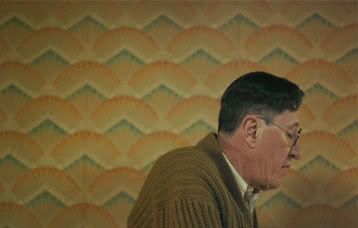
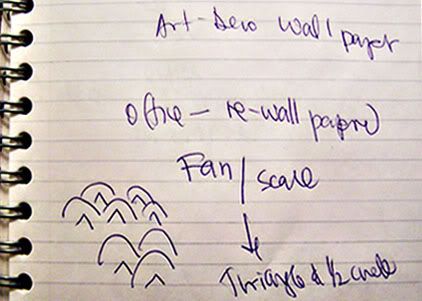
- Logue's home - Art-Deco wallpaper, fan/scale/, triangle and half circle
(below, I have drawn diagram of design):


- Meeting of doctor's wife and Queen
-------------------------------


- View of West Minister Abbey from above, then King is in the frame
- Solemn music
-------------------------------


- Real footage of coronation
- Hitler's speech
- Resignation of PM - "wrong about Hitler"
-------------------------------


- The King's speech
- "Because the Nation believes when I speak, I speak for them. Yet I cannot speak!"
- "Onward!"
-------------------------------


- Beethoven - Speech length of music
- "Conducted" by Logue
- Musical
-------------------------------


- At final credits:
"Through his broadcasts, George VI became a symbol of national
resistance."

Read More...

Saturday, February 20, 2010

Is "None" Singular or Plural?

Well, it can be both.

Follow the link above for full details of the argument, as well as humorous diversions (can one identify a liberal by how he defines - or fails to define - "none")?

Read More...

Monday, October 13, 2008

What's In A Name?

A lot, it seems

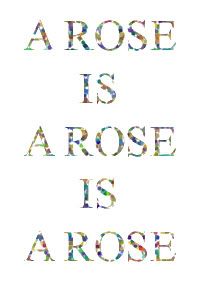
A line from a poem by Gertrude Stein

I know that at the very least, our foreign names are often hard to pronounce, although in these multi-culti times, people don't seem to mind that about mine (and others') and have some curiosity about its meaning. But in earlier years, many names that did not fit in with the general Scottish, English, Irish or even French were camouflaged or changed. Even Eastern Europeans didn't have it easy.

To give a short example, many early famous Jews and Jewish immigrants changed their names to sound less Jewish. Ira and George Gershwin, lyricists of the early 20th century, were born Israel and Jacob Gershowitz. Irving Berlin was born Israel Isidore Beilin. I'm sure the Jewish Johnny Marks, of "Rudolph, the Red Nosed Reindeer" fame, also changed his name.

These Jewish composers and lyricists had to have gotten their energy and creativity from their name changes. A new name, in a new country, is surely a fresh way to start and to fit in. And I'm sure that with each new lyric, including those memorable Christmas songs, their attachment and indebtedness to their new society grew.

These days, though, the more foreign the name, the better. That is why a writer like Takuan Seiyo, who writes for the Brussels Journal and Vdare amongst other publications, not only advertises his unfamiliar name, but also his convoluted background. We are not quite sure who he is. Where does he fit in: in Japan, in Switzerland, in a US university?

Perhaps it is too harsh to blame Takuan Seiyo for what he does. After all, everyone these days gets to keep his name. And not only that, he is encouraged to keep alive whatever strangeness and foreignness that comes with it.

Here is an excerpt from a piece by Takuan Seiyo at the Intellectual Conservative in April 2007. He is writing about the Virginia Tech murders by a Korean national (and student at the university):
East Asian immigrants, as a group, may be the most valuable human capital imported to the United States, perhaps on a par with the Europeans. Our moral and cerebral lassitude is such that if it weren't for the East Asians, the American pool of people with the IQ and discipline necessary to become an engineer, scientist or physician would decline precipitously.
I think it is his unresolved, tangled mental state that makes him write this. But what is wrong with it, you may ask?

Well, firstly, from many empirically sound articles out there, it is clear that the value of “ East Asian” – who exactly are they, Korean, Chinese, Japanese? - immigrant technical workers is their lower wages, and not necessarily their high IQ. Secondly, the lassitude he talks about regarding native American workers is false, since it is government and corporate policies that are providing unfair competition in favor of "East Asian" immigrants, preventing native Americans from working. Finally, there is absolutely no proof that the American pool of qualified people would diminish were it not for the "East Asian" immigrants. What happened for all those centuries in the US and in Europe before these "East Asian" saviors came along?

Now, why bring up Tekuan Seiyo in the first place? Well, for someone who hasn't even resolved his name and thus his place in a (some) society, why should we expect a loyal, or even a clairvoyant explanation of events from him? His mind is after all still with the "East Asians."

His little breach of facts is not a careless mistake, but a state of mind. As a journalist, it is inexcusable that he reports these myths as fact. Rather, it seems that he wants to believe them in order to validate whatever definition he has of himself. And this definition certainly doesn't exclude "East Asian" from his list. His "East Asians" become bigger than life, the saviors of America. Maybe that is the role he wishes for himself.

Read More...

Friday, December 02, 2005

Words

And Reason

The Evengelical Outpost has a great post on hyperbole, exaggeration and metaphor. It is worth the read.

I think the View From the Right is addressing a similar concept when talking about highly emotional feelings which cloud a reasoned or reasonable argument. The example used here is: “I hate Islam… these people are a bunch of savages” deflects from the reasonable “Islam is our mortal enemy and we must defend ourselves from it”.

The Evengelical Outpost does the same deciphering. He quotes a writer who’s views on George Bush resort to “ George Busy is the worst President of the United States of America, ever. Hands down.”

When hyperbole, exaggeration and weak metaphors get in the way of the message, they seem to indicate a personal belligerence. Why should anyone listen to such violent language? As these writers point out, it personalizes the issues, putting the person (and his demons) at the center of the attention.

I’ve found that such style, if it is to be called such, is the language of liberal and female writers. For example, Ann Coulter has many points worth listening to, yet her anger is so palpable in every sentence she writes, that it is difficult to concentrate on her message.

I think most people are willing to listen to reasoned arguments from passionate speakers, not impassioned speakers who belie reasonableness.


Read More...